

Pricing is no longer static in today’s global and highly competitive markets. For multinational organisations operating across Europe and other regions, pricing strategies must adapt to:
- Multi-currency environments
- Complex tax regulations (VAT, intra-community transactions, etc.)
- Global supply chain disruptions
- Customer-specific agreements
- Dynamic discount policies
For CIOs, CTOs, and CISOs, pricing is not only a commercial challenge—it is also a systems challenge. Ensuring application integration between ERP, CRM, eCommerce, and financial systems is critical to maintaining pricing consistency and governance.
Within this context, Advanced Pricing in JD Edwards 9.2 becomes a strategic capability—not just an operational feature.
What Is Advanced Pricing in JD Edwards and How Does It Work?
JD Edwards EnterpriseOne Advanced Pricing is a powerful module designed to manage complex pricing structures directly within sales order processing.
It allows organisations to:
- Define multiple pricing rules
- Apply conditional discounts
- Automate price calculations
- Align pricing with business logic
- Integrate pricing logic across connected systems
From a technical perspective, Advanced Pricing works through:
- Adjustments (discounts, markups, rebates)
- Adjustment Definitions
- Hierarchies (Item/Customer combinations)
- Adjustment Schedules
- Real-time price recalculation during order entry
In environments where application integration is a priority, this ensures that pricing rules defined in JD Edwards are consistently reflected across:
- CRM platforms
- eCommerce portals
- Procurement systems
- BI and analytics tools
When properly configured, Advanced Pricing supports enterprise-grade application integration, maintaining data integrity and reducing manual intervention.
Key Pricing Variables Managed by Advanced Pricing
Advanced Pricing enables price adjustments based on:
- Quantity thresholds
- Customer segmentation
- Product groups
- Payment terms
- Delivery timelines
- Promotional campaigns
- Contractual agreements
This flexibility makes it ideal for companies operating across multiple European jurisdictions and international markets.
How to Create a Price Adjustment in JD Edwards 9.2 in 5 steps
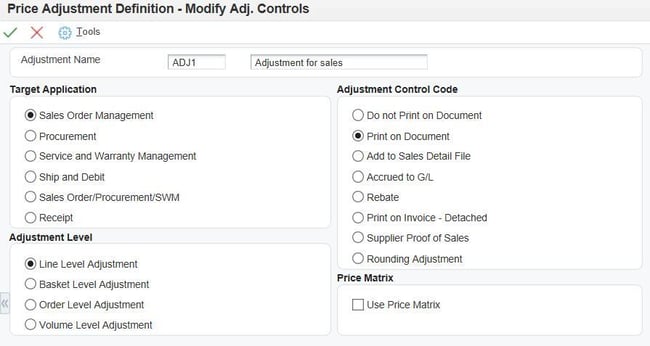
Step 1. Create the Adjustment
- Define the Adjustment Name
- Add a clear description aligned with the pricing policy
- Specify whether it is a discount, markup, or rebate
This step ensures traceability and compliance—particularly relevant for organisations with strong internal control frameworks.

Step 2. Define the Price Adjustment Rules
Once created, configure the adjustment definition:
- Assign calculation method (percentage, fixed amount, formula-based)
- Define effective dates
- Set currency rules if operating internationally
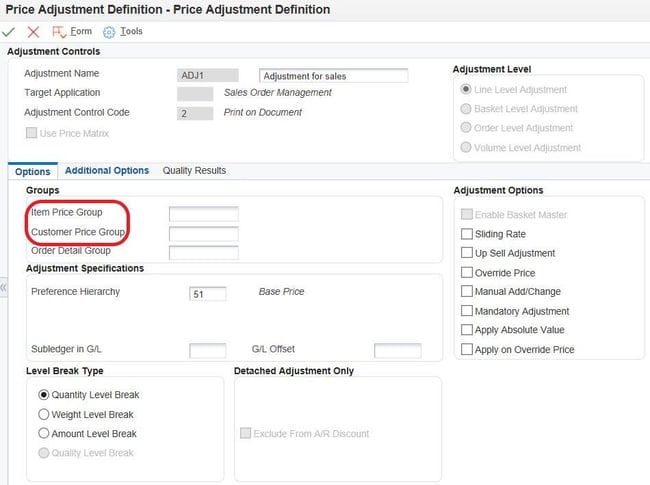
- Specify item or customer groups
If the adjustment applies to:
- A group of items
- A customer group
- Or both
These must be explicitly defined in the relevant configuration fields (marked in red).
This structured approach supports robust application integration, ensuring consistent pricing across all connected systems.
Step 3. Choose the Selection Hierarchy
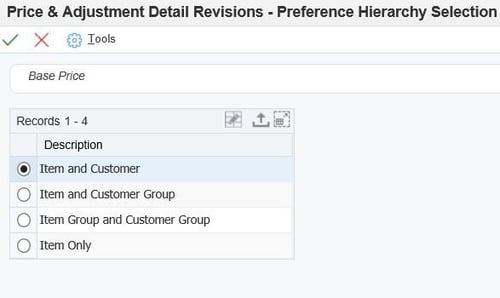
JD Edwards allows multiple selection combinations:
| Selection Type | Use Case |
| Item + Customer | Contract-specific pricing |
| Item + Customer Group | Segment-based discount |
| Item Group + Customer Group | Volume or channel strategy |
| Item Only | Universal product promotion |
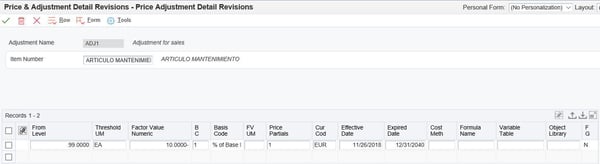
Example scenario: A 10% discount on the base price when a customer purchases 100 units or more.
This tier-based logic is essential for B2B enterprises and integrates seamlessly within the broader integration of application architectures
Step 4. Define the Discount or Adjustment Value
At this stage:
- Enter the percentage or fixed amount
- Define minimum quantity thresholds
- Validate calculation rules
- Test in a controlled environment
Proper validation is critical to avoid cascading pricing errors across integrated systems
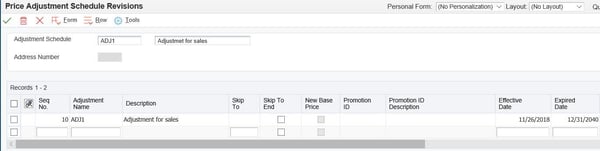
Step 5. Link the Customer or Group to the Adjustment
Finally:
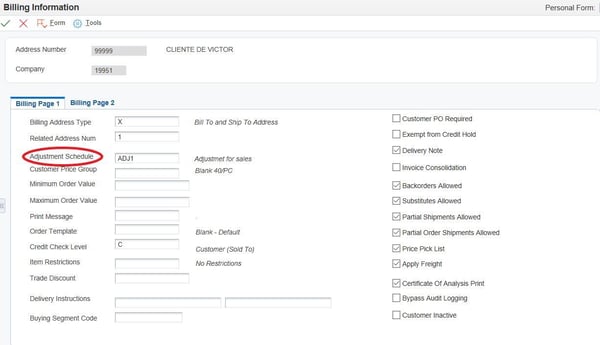
- Assign the adjustment schedule
- Test the configuration in Sales Order Entry
- Verify correct price calculation
This ensures that Advanced Pricing logic flows correctly across the entire ERP ecosystem.
Differences Compared to Other Pricing Solutions
Unlike external pricing engines or custom-built solutions, JD Edwards Advanced Pricing:
- Is natively embedded in the ERP
- Ensures data governance and security
- Reduces dependency on third-party systems
- Supports enterprise-level application integration
- Minimises integration risks and technical debt
For CIOs and CTOs, this means:
- Lower operational complexity
- Stronger compliance control
- Easier maintenance and upgrades
When integrated within a broader enterprise architecture, Advanced Pricing becomes a key component in digital transformation strategies.
Benefits for European and International Enterprises
Although often associated with specific local markets, Advanced Pricing in JD Edwards 9.2 is fully adaptable for organisations operating across Europe and beyond.
Strategic Benefits
- Multi-country pricing alignment
- Support for multi-currency operations
- VAT-aware configuration
- Centralised pricing governance
- Scalability across subsidiaries
Operational Benefits
- Automated discount calculation
- Reduced manual pricing errors
- Faster sales order processing
- Real-time pricing validation
Technology & Security Benefits
- ERP-native logic reduces integration vulnerabilities
- Improved traceability and auditability
- Stronger control over pricing policies
- Seamless integration of applications across the enterprise landscape
For CISOs, this integrated model reduces attack surfaces compared to fragmented pricing solutions.
Use Cases in Key Industries
Manufacturing
- Volume-based discounts
- Channel-specific agreements
- Cross-border distribution pricing
Wholesale & Distribution
- Customer-segment pricing
- Promotional campaigns
- Contractual rebates
Retail & eCommerce
- Tiered discounts
- Omnichannel pricing synchronisation
- Real-time ERP-to-platform application integration
Industrial & Energy Sectors
- Framework agreements
- Long-term contractual pricing
- Dynamic commodity-linked adjustments
Conclusion: Advanced Pricing as a Strategic Asset
In global, digitally connected enterprises, pricing is no longer a simple transactional variable—it is a strategic lever.
Advanced Pricing in JD Edwards EnterpriseOne 9.2 enables organisations to:
- Automate complex pricing logic
- Maintain governance across markets
- Support enterprise-wide application integration
- Enhance profitability and competitiveness
For C-level leaders across Europe and international markets, investing in robust pricing configuration within JD Edwards is not just an operational improvement—it is a strategic enabler of digital transformation.
At Unikal, we help enterprises design, optimise, and secure their JD Edwards environments to ensure pricing strategies are aligned with business objectives and integrated across all systems.