

As many organizations already know, the migration from Oracle Integration Cloud 2 to Generation 3 has become a key step in the evolution of Oracle’s integration platform. Oracle Integration 3 is now the current generation of Oracle Integration, while Oracle Integration Generation 2 reached end of life on August 31, 2025.
Oracle Integration 3 is a fully managed, preconfigured platform designed to connect applications, automate business processes, develop applications, and integrate data across cloud and on-premises environments.
Since the original launch of OIC Gen3, the platform has continued to evolve significantly. In 2026, Oracle has expanded its capabilities around agentic AI, AI-assisted integration development, RPA, security, connectivity, and observability, making the platform considerably broader than a traditional application integration tool.
Throughout this blog, we will explore the main capabilities of Oracle Integration 3 and the features that are particularly relevant for organizations evaluating their integration and automation strategy in 2026.
Main Oracle Integration Cloud features
Oracle Integration provides a set of capabilities designed to cover different integration and automation requirements from a single platform:
- Create business process applications to automate and manage workflows, whether structured or dynamic.
- Design integrations to monitor and manage connections between applications, selecting from a portfolio of hundreds of adapters to connect to Oracle and third-party applications.
- Develop visual applications with integrated Visual Builder functionality.
- Store and retrieve files in Oracle Integration using the embedded SFTP-compliant file server.
- Create integrations that use B2B e-commerce to extend business processes and reach trading partners.
- Build AI-powered and agentic workflows that can interact with integrations, tools, knowledge bases, and business processes.
- Use AI capabilities directly within integration development to accelerate the creation, editing, and testing of integrations.
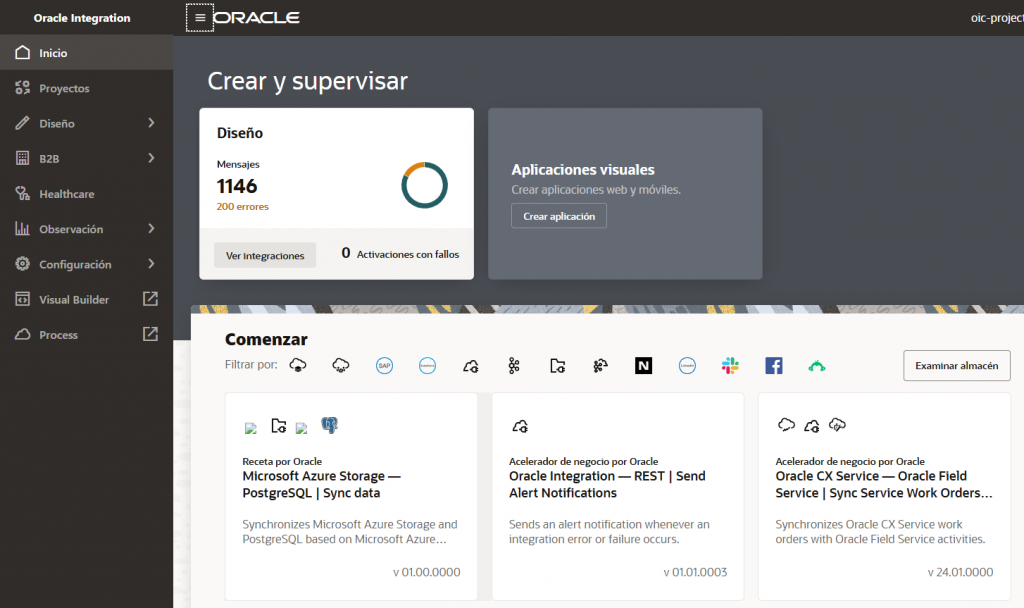
These capabilities allow organizations to connect applications and automate processes without having to build every integration from scratch.
Gen3’s most relevant unique capabilities
In addition to many capabilities already available in previous generations, Oracle Integration 3 introduced several important enhancements. By 2026, some of the most relevant developments are no longer limited to connectivity: AI, agentic automation, RPA, and governance have become increasingly central to the platform.
 RPA (Robot Process Automation)
Robot automation became available in Oracle Integration in February 2025. RPA complements API-based integration by allowing organizations to automate interactions through application user interfaces.
This is particularly useful when an application does not expose an API, when the available API cannot be used for a particular process, or when a legacy application needs to be incorporated into an automated workflow.
RPA has continued to mature in 2026. Oracle Integration 3 now includes capabilities such as AI-assisted self-healing robots, autoscaling environment pools, and improved exception handling. In the 26.07 release, developers can also test robots locally while building them, making it easier to identify and correct automation issues before deployment.
The result is a broader automation approach: APIs where possible, RPA where necessary, and orchestration across both.
 Artificial Intelligence in OIC
AI in Oracle Integration has evolved considerably beyond the ability to call an AI endpoint from an integration.
Oracle Integration 3 now incorporates AI into several stages of the integration lifecycle. For example, AI can assist developers when creating and editing integrations, including generating integrations from natural language and suggesting best practices. In the 26.07 release, Oracle also introduced the ability to generate test cases for integrations using AI.
This changes the role of AI from simply being another service that an integration can invoke to becoming part of the development and automation experience itself.
Agentic AI
One of the most significant developments in Oracle Integration 3 is the expansion of agentic AI capabilities.
Oracle Integration can now support AI agents, agentic AI patterns, AI tools and knowledge bases that can be incorporated into business processes and integrations.
The 26.04 release introduced capabilities such as:
- Versioning and cloning of AI agents and agentic AI patterns.
- ReAct and Plan patterns for agentic workflows.
- Integration of REST-based integrations as AI agent tools.
- Corporate knowledge bases that can be searched from integrations.
- MCP support for exposing tools and knowledge bases to AI systems.
- Human-in-the-loop workflows to introduce human oversight into agentic processes.
The 26.07 release further expanded these capabilities with support for Google Gemini models in agentic AI patterns, callbacks from asynchronous AI tools to agents, and new knowledge-base capabilities, including drag-and-drop document ingestion and support for OCI Generative AI Cohere Embed models.
This is an important evolution for organizations exploring AI agents: integration is no longer only about moving data between applications. It can also provide the actions, business rules, and enterprise context that allow AI agents to participate in real processes.
Improvements in Integration Development
At the developer level, Oracle Integration 3 continues to introduce features aimed at making integration development more efficient.
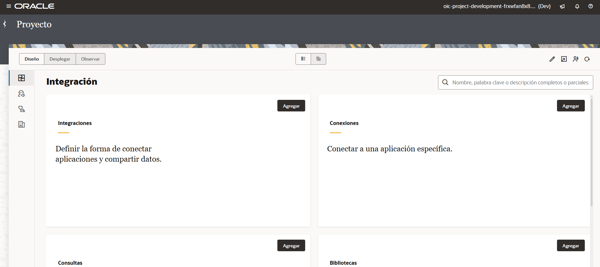
The concept of Projects provides a more structured way to organize integration assets, while the Integration Store offers recipes, accelerators, and adapters that can be reused as starting points.
AI can now assist with integration creation and editing, including automatically configuring trigger and invoke operations in supported scenarios. The platform can also generate integration documentation and, as of 26.07, generate test cases for an integration.
Oracle has also continued expanding its connectivity portfolio.
Examples introduced or enhanced during 2026 include adapters and capabilities for BigQuery, Databricks, ActiveMQ, Microsoft SharePoint, Snowflake, Salesforce, Jira, OCI Cache and Azure Synapse, alongside security and authentication enhancements for several existing adapters.
This matters in hybrid enterprise environments where integration platforms must connect Oracle applications with a wider ecosystem of SaaS, cloud, databases, and legacy systems.
Dashboards and Observability
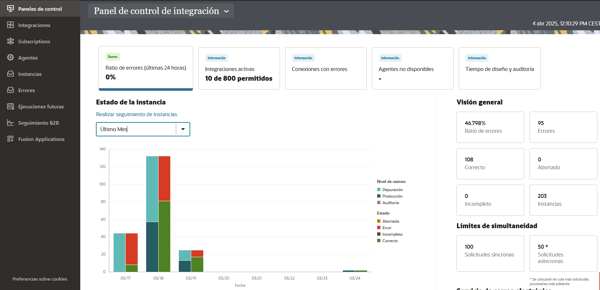
Oracle Integration provides monitoring capabilities to track integration executions and platform activity.
Observability has also been extended in recent releases. Oracle Integration 3 introduced additional service metrics and dimensions, including asynchronous queue depth, File Server connections and scheduler-triggered instances. These metrics can help teams monitor workloads and identify potential capacity or operational issues.
Oracle also provides capabilities to publish activity stream logs to Oracle Log Analytics, which is particularly useful when larger activity-stream payloads exceed OCI public logging limits.
For enterprise integration environments, this operational visibility is increasingly important. Designing an integration is only part of the challenge; being able to understand its behaviour in production is equally important.
Security and APIs
Security remains a key consideration when integrating business-critical applications.
The original Generation 3 architecture introduced important security improvements, including OAuth-based authentication for Oracle APIs instead of the basic username-and-password approach described for Generation 2.
Oracle Integration 3 has continued to strengthen security capabilities. For example, the 26.01 release introduced separate allowlist rules for design-time and runtime access, allowing organizations to apply different access controls depending on whether users are managing integrations or executing them.
The 26.04 release also introduced support for Multi Key Authentication with the REST Adapter and additional authentication mechanisms across adapters, including OAuth 2.0, PKCE, client credentials, and service-principal-based authentication.
These capabilities are particularly relevant when integrations expose sensitive business processes or connect systems across different security domains.
What makes Oracle Integration 3 relevant in 2026?
The evolution of OIC Gen3 can be summarized in four areas:
| Area | Evolution in Oracle Integration 3 |
|---|---|
| Integration | Broader connectivity, projects, adapters, and integration development capabilities |
| Automation | API integration combined with RPA and business process automation |
| AI | AI-assisted development, AI agents, knowledge bases, and agentic patterns |
| Governance & security | Improved authentication, access controls, monitoring and human oversight |
This broader scope is significant because enterprise integration is increasingly becoming the foundation for automation and AI initiatives. AI agents can only execute meaningful business actions when they can securely access the systems, data, and processes that the organization already uses.
Oracle Integration Cloud 3 can provide that connectivity layer while allowing organizations to introduce these capabilities progressively rather than redesigning their entire application landscape.
Conclusion
Oracle Integration 3 has evolved from being primarily an integration and automation platform into a broader foundation for integration, automation, and AI-enabled business processes.
RPA extends automation to applications without suitable APIs. AI assists developers and integration design. Agentic AI introduces new possibilities for autonomous processes, while knowledge bases and human-in-the-loop capabilities help connect AI with enterprise context and governance. At the same time, Oracle continues to expand connectivity, security and monitoring capabilities.
For organizations still evaluating OIC Gen3, the key question is therefore not simply whether it has more features than the previous generation. It is whether the platform can provide the integration, automation and AI foundation required by the organization’s next stage of digital transformation.