
If we ask our colleagues who work on Data Intelligence projects what the key stage in the development of a Business Intelligence system, most will undoubtedly agree on their answer: the design and implementation of the DataWarehouse (DW).
In fact, the distribution of the resources used during a typical Business Intelligence project responds to the following graph:
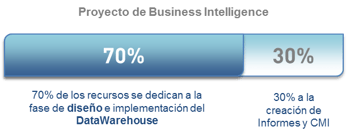
Source: The Datawarehouse ETL Toolkit Ralh Kimball Wiley Publishers
The DataWarehouse is the heart of a business intelligence system and, although its literal translation is data warehouse, it is much more than that. It is an analysis-oriented database that allows the storage of homogeneous and reliable information in a structure based on consultation and hierarchical treatment of the same.
In order for a DataWarehouse to be used as a database, a BI system must be regularly loaded with data from one or more properly integrated and consolidated operational systems to provide a single repository of information.
The procedure of extracting, transforming, and loading data is known as the ETL (Extraction-Transformation-Loading) process and is usually performed using an ETL tool.
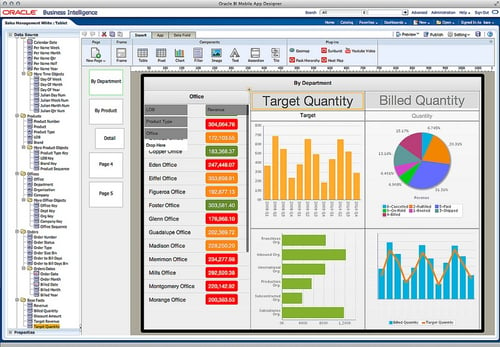
What is Oracle BI and how does it work as an ETL tool?
Oracle BI works as an ETL (Extract, Transform, and Load) tool that allows companies to extract data from multiple sources, transform it according to their needs, and upload it to a data warehouse or business intelligence system.
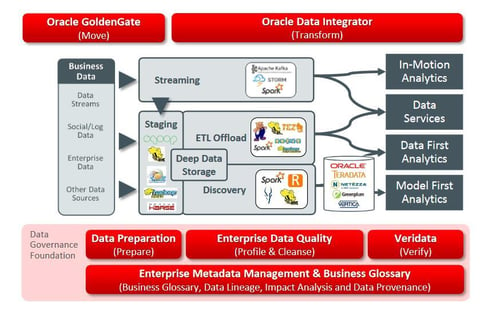
Oracle BI uses a metadata-driven approach, which means it uses a centralized metadata repository to define and organize business objects, transformation rules, and relationships between data. This makes it easier to create reports and analytics, as users can access the data in an intuitive and understandable way.
In addition to its ETL functionality, Oracle BI also offers:
- Data Visualization Capabilities
- Real-time analytics
- Reporting
- Dashboards
This allows companies to make informed, data-driven decisions, identify trends and patterns, and optimize their business processes.
5 Benefits of Using Oracle BI as an ETL Tool
There are several benefits to using Oracle BI as an ETL tool for businesses:
1. Data integration:
Oracle BI allows you to integrate data from multiple sources, such as databases, ERP and CRM systems, Excel files, and more. This facilitates the centralization of data and avoids duplication of efforts in data extraction and transformation.
2. Flexibility in data transformation:
Oracle BI offers a wide range of features and tools to transform data according to business needs. This includes filtering, sorting, aggregation, custom calculations, among others. Users can define transformation rules and apply them easily and efficiently.
3. Process automation:
Oracle BI enables you to automate data extraction, transformation, and loading processes, saving time and reducing errors. Users can schedule tasks and processes to run on a regular basis or based on specific events.
4. Data Visualization:
Oracle BI offers intuitive and customizable data visualization capabilities. Users can create custom reports, charts, and dashboards to analyze and present data effectively.
5. Scalability:
Oracle BI is highly scalable, which means it can handle large volumes of data and grow along with the business. This ensures that the tool adapts to the changing needs of the business as it grows and expands.
Do you want to hear a success story?
Tips for maximizing the use of Oracle BI as an ETL tool
To maximize the use of Oracle BI as an ETL tool, consider the following tips:
Design a robust data model:
Before you start using Oracle BI, make sure you have a robust data model that reflects your business requirements. This will make it easier to extract, transform, and load data.
Define clear transformation rules:
It is important to define clear and understandable transformation rules to ensure the consistency and quality of the transformed data.
Perform extensive testing:
Before deploying Oracle BI in production, perform extensive testing to ensure that data is extracted, transformed, and loaded correctly.
Empower your users:
It provides appropriate training to Oracle BI users so that they can get the most out of the tool. This includes training in the use of the transformation features, creating reports, and interpreting the results.
Keep the tool up to date:
Be sure to maintain the latest version of Oracle BI to take advantage of the latest enhancements and capabilities.
Monitor and optimize performance:
Monitor Oracle BI performance and make adjustments as needed to ensure optimal performance.
Keep data secure:
Implement appropriate security measures to protect sensitive data and ensure compliance with data privacy and security regulations.
The future of Oracle BI in the ETL space is promising. As companies generate more and more data and look for more efficient ways to leverage it, the demand for ETL tools like Oracle BI will continue to grow.
Oracle continues to invest in the development and enhancement of its Analytics Solutions, adding new functionalities and improving performance and scalability. This ensures that the tool remains relevant and competitive in the business intelligence market.