

In most organizations, Oracle Cloud Finance doesn’t live alone. It is the accounting core, but the day-to-day financial is fed by satellite systems: treasury, HR, invoicing, cashiers, BI… All of them generate and consume key information.
That’s why Oracle’s true potential is unleashed when these systems are integrated seamlessly, automated, and architected so that data travels reliably. Here’s how this connected ecosystem is built.
Treasury
The integration between Oracle Cloud and platforms such as Kyriba, FIS Quantum, TMS Orbit or Serrala is already practically a standard in advanced companies. The logic is simple: a TMS must manage liquidity, but Oracle must reflect all those movements in an accounting and operational way.
When both systems are aligned, bank statements flow automatically, are processed using advanced Cash Management rules, and forecasts are adjusted with up-to-date data. It is common to work with REST APIs, encrypted SFTP payloads or integrations via OIC, depending on the level of technical maturity.
The result is more predictable cash flow, with less manual intervention and virtually continuous bank reconciliation. It is not a matter of automating for the sake of automating, but of consolidating cash traceability → accounting → BI.
HR
Something very similar happens in HR. Platforms such as Endalia, Workday, Meta4/Cegid, SuccessFactors or Bizneo are often the master source of employees, positions and organizational structures.
Oracle, on the other hand, needs this information to allocate costs, generate entries, calculate budgets and feed dashboards.
When the integration is well designed, sign-ups and retirements are automatically transmitted, cost centers are updated without user intervention, and payroll data arrives at Oracle with all the necessary accounting segmentation.
More mature companies use FBDI, REST API, or OIC flows to ensure consistency and pre-validations. This alignment eliminates accounting imbalances, avoids rework, and ensures a single organizational model throughout the company.

Billing
In many sectors, turnover is born in external operating systems such as Resiplus, Ekon, or sectoral platforms. Oracle does not generate the activity, but it must become the official repository of revenue, applying rules of AR, accounting, and in some cases IFRS.
Well-built integrations allow services, contracts, or stays to be sent directly to Oracle Cloud, where invoices are automatically generated, accounted for, and validated.
Here, it is common to combine FBDI files, APIs, and pre-validation processes in OICs to ensure data quality. The important thing is not only to issue invoices, but to guarantee complete traceability from the operation to the accounting entry.
Cash and expenses
Expense management solutions such as Pleo, SAP Concur, Expensify, Captio, or Emburse have changed the way many finance teams work. Oracle Cloud, integrated with these platforms, automatically receives card transactions, digitized receipts, and policies already in place.
This type of integration allows the monthly close to be unreliant on emails, blurry photos, or paper compilations. The movements arrive already reconciled, classified, and ready to be posted. Technically, they are usually implemented with REST APIs for entries and metadata, and FBDI uploads for the resulting entries. The impact on closing times and cost control is significant.
BI Analytics
All of these integrations only make sense if the data can be exploited correctly. That’s why tools like Oracle Analytics Cloud, Power BI, or Qlik are often part of the ecosystem.
The connection to Oracle Cloud can be made using OData, BI Publisher, Data Models, or replicas to a Data Warehouse. Once the data is consolidated, finance teams can analyze liquidity, profitability, deviations or forecast KPIs without the need to manually reconcile.
The technical key here is to ensure that Oracle is the authoritative source, preserving the integrity of the processes.
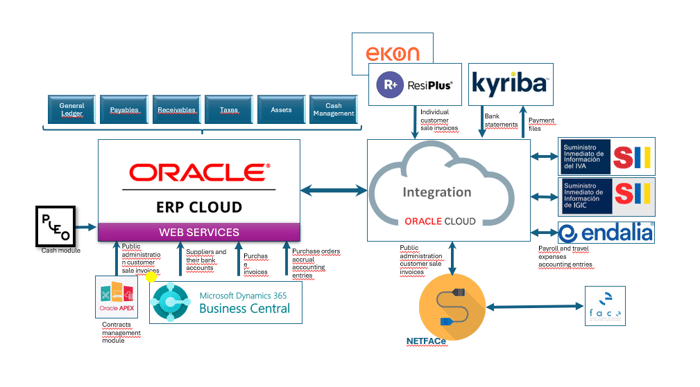
Conclusion: a financial ecosystem cannot be improvised
A well-integrated Oracle Cloud generates a coherent, automated, and auditable financial ecosystem. Data quality improves, closures are accelerated, and decisions are based on reliable information.
But this doesn’t happen by chance: it requires a clear architecture, robust integration design, and the ability to combine APIs, FBDI, OICs, and standard Oracle Cloud services. Of course, at Unikal Tech Partners, we can help you with all these processes.
When everything falls into place, Oracle Cloud becomes not only the financial ERP, but the hub that organizes and synchronizes the entire economic life of the company.