

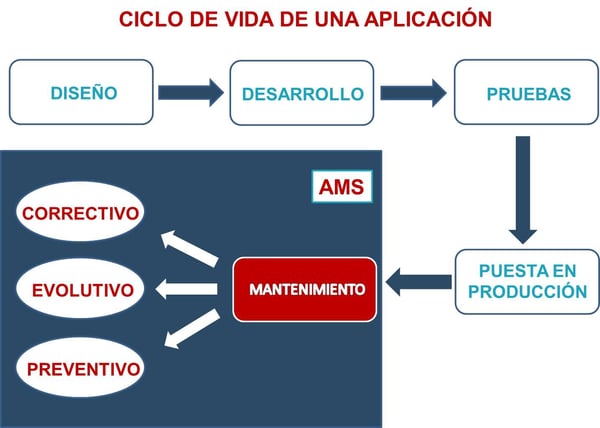
Contrary to what is generally thought, the life of a business application does not end when it is installed in Production, on the contrary, from that moment on, a long period begins in which the application is debugged and evolves as a result of the daily use that is made of it by users, and in which AMS (Application Management Services) services find added value.
This period, in which the application really shows its usefulness in the daily operations of users, is as important or more important than its development, in order to guarantee its adaptation to the needs of users and their satisfaction, the ultimate objective of the implementation of any application.
It is in this period of application support that the AMS (Applicaton Management Services) team comes into play with the aim of guaranteeing the proper functioning of the application and its evolution to adapt to the new needs that arise in its life cycle.
The Role of Analytics in Application Support
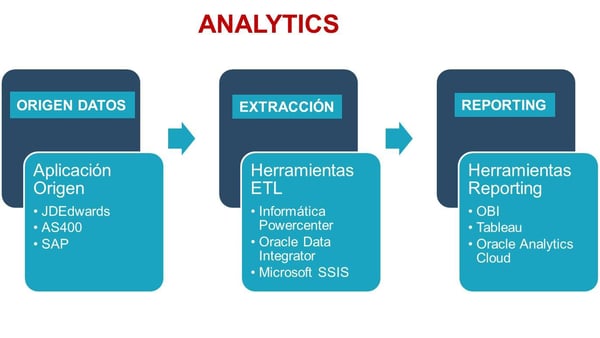
Data analytics or Analytics tools help generate reports from data extracted from a source system.
There are two types of tools:
ETL Process Tools
The objective of these tools is to extract data from the source system and load it into a Data Warehouse (DW) from where it can then be exploited.
It is important that these tools have the ability to access different data sources in order to obtain information from various applications.
Within this group of tools would be the following:
- Informatica Powercenter
- Oracle Data Integrator
- Microsoft SSI
Reporting Tools
The objective of these tools is to build reports based on the data stored in the Data Warehouse (DW).
Within this group of tools would be the following:
- Oracle Business Intelligence (OBI)
- Tableau
As with the rest of the applications, all requests made by the user must be registered in a request registration tool. This will allow effective monitoring of support tasks by having control of the statuses and resolution times of each of the registered requests.
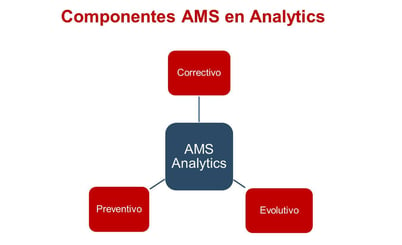
The possibilities offered in the Analytics area within AMS cover the three maintenance components described above:
1. Corrective
It includes all tasks related to incident management, including the analysis and correction of all those reported by users, which may be caused by:
- Application malfunction.
- Incorrect user operations.
- Technical incidents in the infrastructure.
Although the reported error is almost always detected in the reporting, which is what the end user sees, it is possible that its origin may be in any of the necessary layers to reach the report, that is:
- Application of the data source (outside the scope of Analytics).
- Data Extraction and Loading (ETL) Processes
- Reporting processes
2. Evolutionary
Development of new functionalities or modification of existing ones due to new needs raised and which may have their origin in:
- Specific user needs.
- New business requirements.
- Technical evolutions of the system.
- Changes in legal regulations.
These changes can affect either of these two layers (or both at the same time):
- Data Extraction and Uploads (ETL)
- Reporting
3. Preventive
Monitoring of servers and extraction processes and loads that allow problems to be detected before they are reflected in the reporting received by the end user.